
YARIN DIDI:
COLLECTING


Installation photography: Youval Hai
Yarin Didi
Collecting
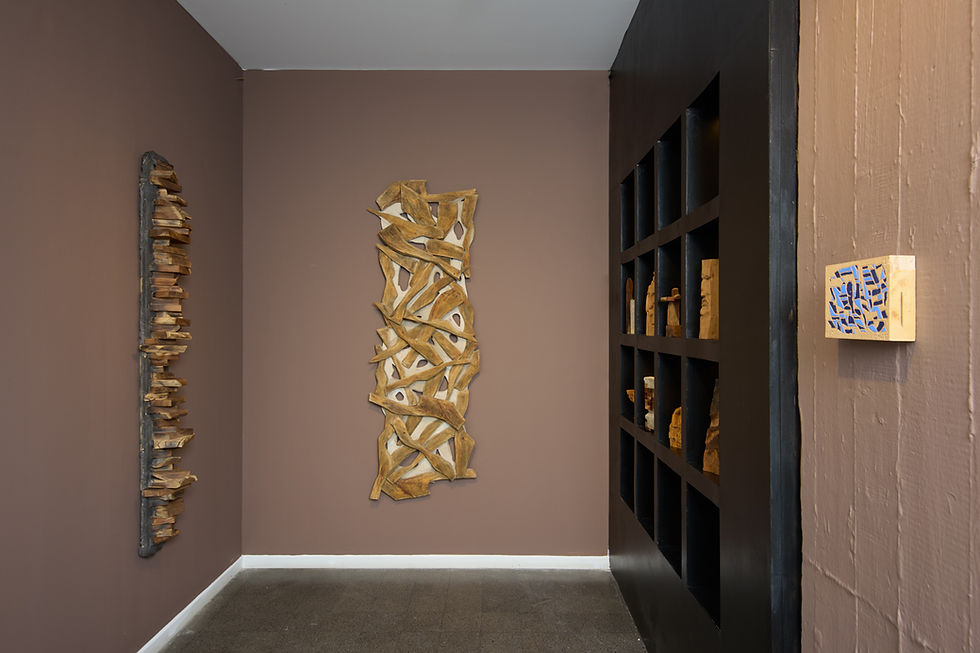
The world that Yarin Didi creates is based on two principles: minimalism and attentiveness. First, material minimalism that relies on natural wood, where the color palette stems almost exclusively from the organic: The natural shades of the wood are maintained, and require careful observation of their nuances, rings, fibers, and hue shifts. Alongside them, he also uses the humble concrete and plaster, which are given an elevated status in the works. The second principle is manifested in Didi’s minimal intervention, which is done with as little touch as possible, with attention and respect for the organic aspects of his raw materials.
The minimalism of the action underscores a crucial aspect of the artist’s approach to the material: Didi collects the pieces of wood in natural forests or from discarded furniture; each piece of wood is selected after a long period of observing, contemplating, and waiting, when eventually, the intervention will involve minimal touch and the action will be precise, distinct, and tailored to that particular piece. The plaster and concrete mixtures fill the spaces between the trees, formulating a sculptural language that does not overpower the material, but rather responds to it, mends and revitalizes it.
Indeed, these works are not permanent, but rather inhabit the gap between the living and the inanimate. The almost magical connection between Didi and the wood he works with gives them a second life after they were felled. Through these, he participates in a dialogue that acknowledges a history of living, blooming, budding, and then felling, chopping, splitting, and sometimes – burning and drying in the oven.
The attitude is as much ethical as it is aesthetic: Who speaks for the tree, and what is the hierarchy in the human-material-environment relationship? Within this domain, material landscapes and gentle, mute or deaf figures take shape, ones whose communication is nonverbal, yet are physically and materially expressive.
Litvak’s new Project Room offers an intimate experience, where the large-scale and small works serve as each other’s habitats. The figures seem to come from a planet where touch, weight, and crevices replace sound. The expanse that unfolds between the figures, the abstract landscapes, and the artist, oscillates between the utopian and the documentary, posing questions about responsibility towards the world and towards those who are only able to make a hushed, hissed voice.